Deprecated: Creation of dynamic property WP_Term::$cat_ID is deprecated in /homepages/15/d218977245/htdocs/wp-includes/category.php on line 357
Deprecated: Creation of dynamic property WP_Term::$category_count is deprecated in /homepages/15/d218977245/htdocs/wp-includes/category.php on line 358
Deprecated: Creation of dynamic property WP_Term::$category_description is deprecated in /homepages/15/d218977245/htdocs/wp-includes/category.php on line 359
Deprecated: Creation of dynamic property WP_Term::$cat_name is deprecated in /homepages/15/d218977245/htdocs/wp-includes/category.php on line 360
Deprecated: Creation of dynamic property WP_Term::$category_nicename is deprecated in /homepages/15/d218977245/htdocs/wp-includes/category.php on line 361
Deprecated: Creation of dynamic property WP_Term::$category_parent is deprecated in /homepages/15/d218977245/htdocs/wp-includes/category.php on line 362
Deprecated: Creation of dynamic property WP_Post::$post_category is deprecated in /homepages/15/d218977245/htdocs/wp-includes/class-wp-post.php on line 266
Deprecated: Creation of dynamic property WP_Post::$post_category is deprecated in /homepages/15/d218977245/htdocs/wp-includes/class-wp-post.php on line 266
Last weekend, I remotely gave a talk at the Mecahdemica Conference on Science Fiction Utopias from the Muslim World. The slides for my presentation is at the bottom of this post. Future as the Present: Science Fiction Utopias and Dystopias from the Muslim World Muhammad Aurangzeb Ahmad Abstract: The utopias and dystopias produced by the Muslim world … Continue reading Utopias and Dystopias from the Muslim World]]>
Deprecated: Creation of dynamic property WP_Post::$post_category is deprecated in /homepages/15/d218977245/htdocs/wp-includes/class-wp-post.php on line 266
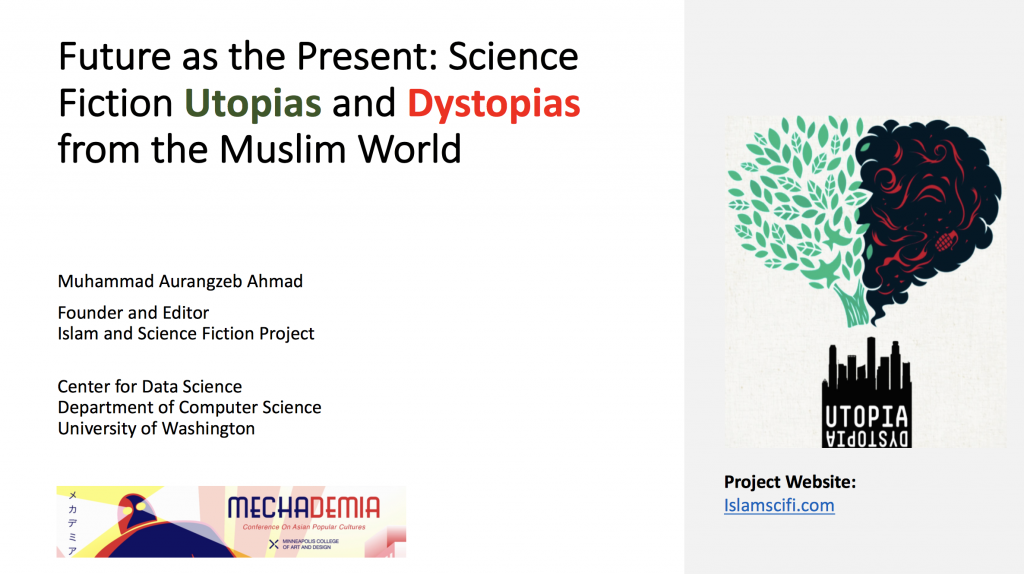
Future as the Present: Science Fiction Utopias and Dystopias from the Muslim World
Muhammad Aurangzeb Ahmad
Abstract: The utopias and dystopias produced by the Muslim world in the last 100 years are a good proxy of the aspirations of Muslim cultures. The themes from some representative utopian/dystopian works will be explored here. The first feminist science fiction utopia was imagined by the Bengali Muslim author Ruqqaiya Sakawat Hussain in 1905. In the 1930s, the Turkish author Raif Necdet imagined a secular Turkish utopia which had broken free from its past. Al-Bud al-Khamis (1987) by Ahmad Raif imagines a group of humans who have become disillusioned with Earth. They arrive on Mars where they find a tolerant and non-violent utopian society, run by an Islam like religion.
Around the same time, the Turkish author Ali Nar envisions a very different utopia in Uzay Ciftcileri (Space Farmers) where group of astronauts from Earth go on a journey, inspired from the Ascension journey of Prophet Muhammad, and land on a utopian planet where the society is organized according to a mystical form of Islam. Ahmad Tawfiq’s (2011) dystopian novel Utopia envisions a near future Arab society rife with deep class divisions where the rich live in Elysium like enclaves and the poor barely have enough to survive. Basma Abdel Aziz’s (2016) novel The Queue is set in a Kafkaesque world where the hopes of Arab Spring have been crushed. It is set in the aftermath of an unsuccessful uprising where the helpless citizens struggle to get by in their daily lives against an absurd sinister dictatorship.
Powerpoint | PDF
]]>Deprecated: Creation of dynamic property WP_Post::$post_category is deprecated in /homepages/15/d218977245/htdocs/wp-includes/class-wp-post.php on line 266
Deprecated: Creation of dynamic property WP_Post::$post_category is deprecated in /homepages/15/d218977245/htdocs/wp-includes/class-wp-post.php on line 266
http://www.islamscifi.com/utopias-and-dystopias-from-the-muslim-world/feed/
Deprecated: Creation of dynamic property WP_Term::$cat_ID is deprecated in /homepages/15/d218977245/htdocs/wp-includes/category.php on line 357
Deprecated: Creation of dynamic property WP_Term::$category_count is deprecated in /homepages/15/d218977245/htdocs/wp-includes/category.php on line 358
Deprecated: Creation of dynamic property WP_Term::$category_description is deprecated in /homepages/15/d218977245/htdocs/wp-includes/category.php on line 359
Deprecated: Creation of dynamic property WP_Term::$cat_name is deprecated in /homepages/15/d218977245/htdocs/wp-includes/category.php on line 360
Deprecated: Creation of dynamic property WP_Term::$category_nicename is deprecated in /homepages/15/d218977245/htdocs/wp-includes/category.php on line 361
Deprecated: Creation of dynamic property WP_Term::$category_parent is deprecated in /homepages/15/d218977245/htdocs/wp-includes/category.php on line 362
Deprecated: Creation of dynamic property WP_Term::$cat_ID is deprecated in /homepages/15/d218977245/htdocs/wp-includes/category.php on line 357
Deprecated: Creation of dynamic property WP_Term::$category_count is deprecated in /homepages/15/d218977245/htdocs/wp-includes/category.php on line 358
Deprecated: Creation of dynamic property WP_Term::$category_description is deprecated in /homepages/15/d218977245/htdocs/wp-includes/category.php on line 359
Deprecated: Creation of dynamic property WP_Term::$cat_name is deprecated in /homepages/15/d218977245/htdocs/wp-includes/category.php on line 360
Deprecated: Creation of dynamic property WP_Term::$category_nicename is deprecated in /homepages/15/d218977245/htdocs/wp-includes/category.php on line 361
Deprecated: Creation of dynamic property WP_Term::$category_parent is deprecated in /homepages/15/d218977245/htdocs/wp-includes/category.php on line 362
Deprecated: Creation of dynamic property WP_Post::$post_category is deprecated in /homepages/15/d218977245/htdocs/wp-includes/class-wp-post.php on line 266
Deprecated: Creation of dynamic property WP_Post::$post_category is deprecated in /homepages/15/d218977245/htdocs/wp-includes/class-wp-post.php on line 266
The folks over at the Middle East Institute interviewed me regarding Arab Science Fiction, the interview is now up on their website. Interview at the Middle East Institute – Singapore National University]]>
Deprecated: Creation of dynamic property WP_Post::$post_category is deprecated in /homepages/15/d218977245/htdocs/wp-includes/class-wp-post.php on line 266

The folks over at the Middle East Institute interviewed me regarding Arab Science Fiction, the interview is now up on their website.
Interview at the Middle East Institute – Singapore National University
]]>Deprecated: Creation of dynamic property WP_Post::$post_category is deprecated in /homepages/15/d218977245/htdocs/wp-includes/class-wp-post.php on line 266
Deprecated: Creation of dynamic property WP_Post::$post_category is deprecated in /homepages/15/d218977245/htdocs/wp-includes/class-wp-post.php on line 266
http://www.islamscifi.com/interview-at-the-middle-east-institute-singapore-national-university/feed/
Deprecated: Creation of dynamic property WP_Term::$cat_ID is deprecated in /homepages/15/d218977245/htdocs/wp-includes/category.php on line 357
Deprecated: Creation of dynamic property WP_Term::$category_count is deprecated in /homepages/15/d218977245/htdocs/wp-includes/category.php on line 358
Deprecated: Creation of dynamic property WP_Term::$category_description is deprecated in /homepages/15/d218977245/htdocs/wp-includes/category.php on line 359
Deprecated: Creation of dynamic property WP_Term::$cat_name is deprecated in /homepages/15/d218977245/htdocs/wp-includes/category.php on line 360
Deprecated: Creation of dynamic property WP_Term::$category_nicename is deprecated in /homepages/15/d218977245/htdocs/wp-includes/category.php on line 361
Deprecated: Creation of dynamic property WP_Term::$category_parent is deprecated in /homepages/15/d218977245/htdocs/wp-includes/category.php on line 362
Deprecated: Creation of dynamic property WP_Term::$cat_ID is deprecated in /homepages/15/d218977245/htdocs/wp-includes/category.php on line 357
Deprecated: Creation of dynamic property WP_Term::$category_count is deprecated in /homepages/15/d218977245/htdocs/wp-includes/category.php on line 358
Deprecated: Creation of dynamic property WP_Term::$category_description is deprecated in /homepages/15/d218977245/htdocs/wp-includes/category.php on line 359
Deprecated: Creation of dynamic property WP_Term::$cat_name is deprecated in /homepages/15/d218977245/htdocs/wp-includes/category.php on line 360
Deprecated: Creation of dynamic property WP_Term::$category_nicename is deprecated in /homepages/15/d218977245/htdocs/wp-includes/category.php on line 361
Deprecated: Creation of dynamic property WP_Term::$category_parent is deprecated in /homepages/15/d218977245/htdocs/wp-includes/category.php on line 362
Deprecated: Creation of dynamic property WP_Post::$post_category is deprecated in /homepages/15/d218977245/htdocs/wp-includes/class-wp-post.php on line 266
As promised here is the video of our Geeks of Color Assemble panel at the New York Comic Con (NYCC). I have been meaning to post these for a while but my mind has been fixated on the recent tragic event. The news of this video was also the last thing about the Islam and … Continue reading Video of Geeks of Color Assemble NYCC Panel Video]]>
Deprecated: Creation of dynamic property WP_Post::$post_category is deprecated in /homepages/15/d218977245/htdocs/wp-includes/class-wp-post.php on line 266
Deprecated: Creation of dynamic property WP_Post::$post_category is deprecated in /homepages/15/d218977245/htdocs/wp-includes/class-wp-post.php on line 266
http://www.islamscifi.com/video-of-geeks-of-color-assemble-nycc-panel-video/feed/
Deprecated: Creation of dynamic property WP_Term::$cat_ID is deprecated in /homepages/15/d218977245/htdocs/wp-includes/category.php on line 357
Deprecated: Creation of dynamic property WP_Term::$category_count is deprecated in /homepages/15/d218977245/htdocs/wp-includes/category.php on line 358
Deprecated: Creation of dynamic property WP_Term::$category_description is deprecated in /homepages/15/d218977245/htdocs/wp-includes/category.php on line 359
Deprecated: Creation of dynamic property WP_Term::$cat_name is deprecated in /homepages/15/d218977245/htdocs/wp-includes/category.php on line 360
Deprecated: Creation of dynamic property WP_Term::$category_nicename is deprecated in /homepages/15/d218977245/htdocs/wp-includes/category.php on line 361
Deprecated: Creation of dynamic property WP_Term::$category_parent is deprecated in /homepages/15/d218977245/htdocs/wp-includes/category.php on line 362
Deprecated: Creation of dynamic property WP_Post::$post_category is deprecated in /homepages/15/d218977245/htdocs/wp-includes/class-wp-post.php on line 266
Deprecated: Creation of dynamic property WP_Post::$post_category is deprecated in /homepages/15/d218977245/htdocs/wp-includes/class-wp-post.php on line 266
(Image Source: PC Magazine) The Minorities in Fandom Panel at the New York Comic Con was a huge success. We had a house full and in fact the number of audience members that were allowed in the room because of capacity issues capped out ten minutes before the panel evan began. The other panelists were … Continue reading Geeks of Color Assemble Panel at NYCC]]>
Deprecated: Creation of dynamic property WP_Post::$post_category is deprecated in /homepages/15/d218977245/htdocs/wp-includes/class-wp-post.php on line 266

(Image Source: PC Magazine)
The Minorities in Fandom Panel at the New York Comic Con was a huge success. We had a house full and in fact the number of audience members that were allowed in the room because of capacity issues capped out ten minutes before the panel evan began. The other panelists were award-winning writer N.K. Jemisin, critic Jeffrey L. Wilson, Emmanuel Ortiz of Nerd Caliber, Science Fiction writer and Musician Muse en Lystrala, cosplayers, cosplayer Ger Tysk, cosplayer Jay Justice and our wonderful moderator Diana Pho who runs the Beyond Victoriana multicultural steampunk website. The panelists as well as the audience represented a diverse group of people and also a good demonstration of how people of different backgrounds can stand in solidarity with one another.
The issues that came up during the discussion ranged from representation of minorities in Science Fiction and Fantasy to people of color looking out for one another instead of just their own groups. Representations of minorities in these genres has certainly improved but we still have a long way to go and this improvement should not lull us into a false sense of security. There was also the recognition that minorities need to reach out to one another instead of restricting themselves to dialoging with the dominant group. There will always be people who will not be accepting but that should not deter a person from doing what they are doing.
The event was covered by the PC Magazine as well as the well known Science Fiction and Fantasy Publisher Tor on their website. Like the other panelists and the attendees I also wished that the time allocated to the panel should have been longer. Last and certainly not the least a huge thank and applause to Diana Pho of Beyond Victoriana – Multicultural Steampunk.
Be sure to like Islam and Science Fiction on Facebook and follow us on Twitter.
]]>Deprecated: Creation of dynamic property WP_Post::$post_category is deprecated in /homepages/15/d218977245/htdocs/wp-includes/class-wp-post.php on line 266
Deprecated: Creation of dynamic property WP_Post::$post_category is deprecated in /homepages/15/d218977245/htdocs/wp-includes/class-wp-post.php on line 266
http://www.islamscifi.com/geeks-of-color-assemble-panel-at-nycc/feed/
Deprecated: Creation of dynamic property WP_Term::$cat_ID is deprecated in /homepages/15/d218977245/htdocs/wp-includes/category.php on line 357
Deprecated: Creation of dynamic property WP_Term::$category_count is deprecated in /homepages/15/d218977245/htdocs/wp-includes/category.php on line 358
Deprecated: Creation of dynamic property WP_Term::$category_description is deprecated in /homepages/15/d218977245/htdocs/wp-includes/category.php on line 359
Deprecated: Creation of dynamic property WP_Term::$cat_name is deprecated in /homepages/15/d218977245/htdocs/wp-includes/category.php on line 360
Deprecated: Creation of dynamic property WP_Term::$category_nicename is deprecated in /homepages/15/d218977245/htdocs/wp-includes/category.php on line 361
Deprecated: Creation of dynamic property WP_Term::$category_parent is deprecated in /homepages/15/d218977245/htdocs/wp-includes/category.php on line 362
Deprecated: Creation of dynamic property WP_Post::$post_category is deprecated in /homepages/15/d218977245/htdocs/wp-includes/class-wp-post.php on line 266
Deprecated: Creation of dynamic property WP_Post::$post_category is deprecated in /homepages/15/d218977245/htdocs/wp-includes/class-wp-post.php on line 266
I will be in next weekend and the whole weekend after that. If anyone wants to meet up drop me a line. Next Saturday i.e., October 12, 2013 I will be part of a panel at the New York ComicCon. If you are around then be sure to stop by and say hi. Here is … Continue reading Islam and Sci Fi in NYC and the New York ComicCon]]>
Deprecated: Creation of dynamic property WP_Post::$post_category is deprecated in /homepages/15/d218977245/htdocs/wp-includes/class-wp-post.php on line 266

I will be in next weekend and the whole weekend after that. If anyone wants to meet up drop me a line. Next Saturday i.e., October 12, 2013 I will be part of a panel at the New York ComicCon. If you are around then be sure to stop by and say hi. Here is detailed information about the panel!
Geeks of Color Assemble! : Minorities in Fandom
Date: Saturday, October 12
6:30 pm – 7:30 pm
Location: 1A17
Speakers: Diana Pho, Ger Tysk, Jay Justice, Jeffrey L. Wilson, Muhammad Aurangzeb Ahmad, Muse En Lystrala, Emmanuel Ortiz, N.K. Jemisin
Description:
From Community’s Abed and Troy to Miles Morales as Spiderman to Rinko Kikuchi and Idris Elba starring in Pacific Rim, this is obvious: people of color are impacting geek media. What challenges, however, do minorities still face? Discuss being a geek of color in comics, cosplay, videos games, steampunk and more. Speakers: Hugo & Nebula Award-nominated writer N.K. Jemisin, Jeffrey L. Wilson, Emmanuel Ortiz, Muse en Lystrala, Muhammad Aurangzeb Ahmad, Ger Tysk, and Jay Justice. Moderated by Diana Pho (a.k.a. Ay-leen the Peacemaker) of Tor Books and Tor.com.
Deprecated: Creation of dynamic property WP_Post::$post_category is deprecated in /homepages/15/d218977245/htdocs/wp-includes/class-wp-post.php on line 266
Deprecated: Creation of dynamic property WP_Post::$post_category is deprecated in /homepages/15/d218977245/htdocs/wp-includes/class-wp-post.php on line 266
http://www.islamscifi.com/islam-and-sci-fi-in-nyc-and-the-new-york-comiccon/feed/
Deprecated: Creation of dynamic property WP_Term::$cat_ID is deprecated in /homepages/15/d218977245/htdocs/wp-includes/category.php on line 357
Deprecated: Creation of dynamic property WP_Term::$category_count is deprecated in /homepages/15/d218977245/htdocs/wp-includes/category.php on line 358
Deprecated: Creation of dynamic property WP_Term::$category_description is deprecated in /homepages/15/d218977245/htdocs/wp-includes/category.php on line 359
Deprecated: Creation of dynamic property WP_Term::$cat_name is deprecated in /homepages/15/d218977245/htdocs/wp-includes/category.php on line 360
Deprecated: Creation of dynamic property WP_Term::$category_nicename is deprecated in /homepages/15/d218977245/htdocs/wp-includes/category.php on line 361
Deprecated: Creation of dynamic property WP_Term::$category_parent is deprecated in /homepages/15/d218977245/htdocs/wp-includes/category.php on line 362
Deprecated: Creation of dynamic property WP_Post::$post_category is deprecated in /homepages/15/d218977245/htdocs/wp-includes/class-wp-post.php on line 266
The New York Comic Con (NYCC) is almost upon us. I (Muhammad Aurangzeb Ahmad) will be on a panel at NYCC. For the uninitiated NYCC is one of the largest Cons in the world. More than a hundred thousand people are expected to attend the convention this year. This year Sylvester Stallone, Chloe Moretz, William … Continue reading Geeks of Color Assemble! : Minorities in Fandom (New York Comic Con)]]>

The New York Comic Con (NYCC) is almost upon us. I (Muhammad Aurangzeb Ahmad) will be on a panel at NYCC. For the uninitiated NYCC is one of the largest Cons in the world. More than a hundred thousand people are expected to attend the convention this year. This year Sylvester Stallone, Chloe Moretz, William Shatner will be guests at the New York Comic Con. If any of you folks are planning to attend or at least are in the NY area then let me know and we can meet up. Here is detailed information on the panel.
Title: Geeks of Color Assemble! : Minorities in Fandom
Date: 10/12/2013
Time: 6:30 PM – 7:30 PM
Location: 1A17
Speakers: Diana Pho, N.K. Jemisin, Jeffrey L. Wilson, Emmanuel Ortiz, Jay Justice, Muse En Lystrala, Muhammad Aurangzeb Ahmad, Ger Tysk
Description: From Community’s Abed and Troy to Miles Morales as Spiderman to Rinko Kikuchi and Idris Elba starring in Pacific Rim, this is obvious: people of color are impacting geek media. What challenges, however, do minorities still face? Discuss being a geek of color in comics, cosplay, videos games, steampunk, and more. Speakers: Hugo & Nebula Award-nominated writer N.K. Jemisin, Jeffrey L. Wilson, Emmanuel Ortiz, Muse en Lystrala, Muhammad Aurangzeb Ahmad, Ger Tysk, and Jay Justice. Moderated by Diana Pho (a.k.a. Ay-leen the Peacemaker) of Tor Books and Tor.com.
]]>Deprecated: Creation of dynamic property WP_Post::$post_category is deprecated in /homepages/15/d218977245/htdocs/wp-includes/class-wp-post.php on line 266
Deprecated: Creation of dynamic property WP_Post::$post_category is deprecated in /homepages/15/d218977245/htdocs/wp-includes/class-wp-post.php on line 266
http://www.islamscifi.com/geeks-of-color-assemble-minorities-in-fandom-new-york-comic-con/feed/
Deprecated: Creation of dynamic property WP_Term::$cat_ID is deprecated in /homepages/15/d218977245/htdocs/wp-includes/category.php on line 357
Deprecated: Creation of dynamic property WP_Term::$category_count is deprecated in /homepages/15/d218977245/htdocs/wp-includes/category.php on line 358
Deprecated: Creation of dynamic property WP_Term::$category_description is deprecated in /homepages/15/d218977245/htdocs/wp-includes/category.php on line 359
Deprecated: Creation of dynamic property WP_Term::$cat_name is deprecated in /homepages/15/d218977245/htdocs/wp-includes/category.php on line 360
Deprecated: Creation of dynamic property WP_Term::$category_nicename is deprecated in /homepages/15/d218977245/htdocs/wp-includes/category.php on line 361
Deprecated: Creation of dynamic property WP_Term::$category_parent is deprecated in /homepages/15/d218977245/htdocs/wp-includes/category.php on line 362
Deprecated: Creation of dynamic property WP_Term::$cat_ID is deprecated in /homepages/15/d218977245/htdocs/wp-includes/category.php on line 357
Deprecated: Creation of dynamic property WP_Term::$category_count is deprecated in /homepages/15/d218977245/htdocs/wp-includes/category.php on line 358
Deprecated: Creation of dynamic property WP_Term::$category_description is deprecated in /homepages/15/d218977245/htdocs/wp-includes/category.php on line 359
Deprecated: Creation of dynamic property WP_Term::$cat_name is deprecated in /homepages/15/d218977245/htdocs/wp-includes/category.php on line 360
Deprecated: Creation of dynamic property WP_Term::$category_nicename is deprecated in /homepages/15/d218977245/htdocs/wp-includes/category.php on line 361
Deprecated: Creation of dynamic property WP_Term::$category_parent is deprecated in /homepages/15/d218977245/htdocs/wp-includes/category.php on line 362
Deprecated: Creation of dynamic property WP_Term::$cat_ID is deprecated in /homepages/15/d218977245/htdocs/wp-includes/category.php on line 357
Deprecated: Creation of dynamic property WP_Term::$category_count is deprecated in /homepages/15/d218977245/htdocs/wp-includes/category.php on line 358
Deprecated: Creation of dynamic property WP_Term::$category_description is deprecated in /homepages/15/d218977245/htdocs/wp-includes/category.php on line 359
Deprecated: Creation of dynamic property WP_Term::$cat_name is deprecated in /homepages/15/d218977245/htdocs/wp-includes/category.php on line 360
Deprecated: Creation of dynamic property WP_Term::$category_nicename is deprecated in /homepages/15/d218977245/htdocs/wp-includes/category.php on line 361
Deprecated: Creation of dynamic property WP_Term::$category_parent is deprecated in /homepages/15/d218977245/htdocs/wp-includes/category.php on line 362
Deprecated: Creation of dynamic property WP_Post::$post_category is deprecated in /homepages/15/d218977245/htdocs/wp-includes/class-wp-post.php on line 266
Deprecated: Creation of dynamic property WP_Post::$post_category is deprecated in /homepages/15/d218977245/htdocs/wp-includes/class-wp-post.php on line 266
I will be on a couple of panels at the 36th annual WisCon 23 this weekend being held in Madison, Wisconsin. WisCon is the world’s leading feminist-oriented science fiction convention and conference. I will mainly be talking about Science Fiction in translation (mainly from the Muslim world) and Science Fiction with Muslim and/or Islamic themes. … Continue reading WisCon 2012: Panel on Islam and SciFi]]>
Deprecated: Creation of dynamic property WP_Post::$post_category is deprecated in /homepages/15/d218977245/htdocs/wp-includes/class-wp-post.php on line 266

I will be on a couple of panels at the 36th annual WisCon 23 this weekend being held in Madison, Wisconsin. WisCon is the world’s leading feminist-oriented science fiction convention and conference. I will mainly be talking about Science Fiction in translation (mainly from the Muslim world) and Science Fiction with Muslim and/or Islamic themes. Be sure to stop by if you are the conference.
Speculative Fiction in/and Translation
Date: Sat, 8:30–9:45 am
Room: Capitol B
Moderator: Emily Jiang.
Participants Emily Jiang, Muhammad Aurangzeb Ahmad, Dr. Janice M. Bogstad, Larisa Mikhaylova
2011 saw the first ever Science Fiction and Fantasy Translation Awards. Let’s discuss the winners, the state of F&SF translation (who gets translated? into and from which languages? how interested are publishers? does anybody actually get paid for translating this stuff?), and efforts to encourage a world consciousness in the SF community (like the VanderMeers’ Weird Fiction Review). We’ll also cover where readers can go to discover F&SF in translation.
The Arab/Muslim “East” in SF
Date: Sat, 1:00–2:15 pm
Room: Wisconsin
Moderator: Sofia Samatar
Participants: Sofia Samatar, Muhammad Aurangzeb Ahmad, Saladin Ahmed, Saira Ali, Na’amen Gobert Tilahun
Description: Let’s look at depictions of the Arab/Muslim “East” in SF. We’ll review the recent literature (for example Ian McDonald, Howard Jones, Kameron Hurley, Saladin Ahmed), discussing the good, the bad and the ugly. But it shouldn’t stop there: Let’s also look at how SF readers and writers can engage fruitfully across cultures. We don’t just want to write about English fairies, but how do we write about djinn? Does it matter that tons of people believe in them and have ideas about them based on the Qur’an? What do we need to think about? And where can we find helpful information?
Deprecated: Creation of dynamic property WP_Term::$cat_ID is deprecated in /homepages/15/d218977245/htdocs/wp-includes/category.php on line 357
Deprecated: Creation of dynamic property WP_Term::$category_count is deprecated in /homepages/15/d218977245/htdocs/wp-includes/category.php on line 358
Deprecated: Creation of dynamic property WP_Term::$category_description is deprecated in /homepages/15/d218977245/htdocs/wp-includes/category.php on line 359
Deprecated: Creation of dynamic property WP_Term::$cat_name is deprecated in /homepages/15/d218977245/htdocs/wp-includes/category.php on line 360
Deprecated: Creation of dynamic property WP_Term::$category_nicename is deprecated in /homepages/15/d218977245/htdocs/wp-includes/category.php on line 361
Deprecated: Creation of dynamic property WP_Term::$category_parent is deprecated in /homepages/15/d218977245/htdocs/wp-includes/category.php on line 362
Deprecated: Creation of dynamic property WP_Term::$cat_ID is deprecated in /homepages/15/d218977245/htdocs/wp-includes/category.php on line 357
Deprecated: Creation of dynamic property WP_Term::$category_count is deprecated in /homepages/15/d218977245/htdocs/wp-includes/category.php on line 358
Deprecated: Creation of dynamic property WP_Term::$category_description is deprecated in /homepages/15/d218977245/htdocs/wp-includes/category.php on line 359
Deprecated: Creation of dynamic property WP_Term::$cat_name is deprecated in /homepages/15/d218977245/htdocs/wp-includes/category.php on line 360
Deprecated: Creation of dynamic property WP_Term::$category_nicename is deprecated in /homepages/15/d218977245/htdocs/wp-includes/category.php on line 361
Deprecated: Creation of dynamic property WP_Term::$category_parent is deprecated in /homepages/15/d218977245/htdocs/wp-includes/category.php on line 362
Deprecated: Creation of dynamic property WP_Term::$cat_ID is deprecated in /homepages/15/d218977245/htdocs/wp-includes/category.php on line 357
Deprecated: Creation of dynamic property WP_Term::$category_count is deprecated in /homepages/15/d218977245/htdocs/wp-includes/category.php on line 358
Deprecated: Creation of dynamic property WP_Term::$category_description is deprecated in /homepages/15/d218977245/htdocs/wp-includes/category.php on line 359
Deprecated: Creation of dynamic property WP_Term::$cat_name is deprecated in /homepages/15/d218977245/htdocs/wp-includes/category.php on line 360
Deprecated: Creation of dynamic property WP_Term::$category_nicename is deprecated in /homepages/15/d218977245/htdocs/wp-includes/category.php on line 361
Deprecated: Creation of dynamic property WP_Term::$category_parent is deprecated in /homepages/15/d218977245/htdocs/wp-includes/category.php on line 362
Deprecated: Creation of dynamic property WP_Post::$post_category is deprecated in /homepages/15/d218977245/htdocs/wp-includes/class-wp-post.php on line 266
Deprecated: Creation of dynamic property WP_Post::$post_category is deprecated in /homepages/15/d218977245/htdocs/wp-includes/class-wp-post.php on line 266
PCA/ACA: Conference April 11-14, Boston MA April 14, 2012 3:00 pm -4:30 pm, Conference Website Copley Marriott Hotel in Boston Special Roundtable Session: Countering the Master Narrative: Locating Muslims and Islam in Science Fiction, Fantasy, and Comics Abstract: Science fiction, fantasy, and comic book literature is experiencing a “revival” in modern day Muslim communities with … Continue reading Islam and Sci-Fi Panel at PCA/ACA Boston April 11-14, 2012]]>
Deprecated: Creation of dynamic property WP_Post::$post_category is deprecated in /homepages/15/d218977245/htdocs/wp-includes/class-wp-post.php on line 266

PCA/ACA: Conference April 11-14, Boston MA
April 14, 2012 3:00 pm -4:30 pm, Conference Website
Copley Marriott Hotel in Boston
Special Roundtable Session: Countering the Master Narrative: Locating Muslims and Islam in Science Fiction, Fantasy, and Comics
Abstract: Science fiction, fantasy, and comic book literature is experiencing a “revival” in modern day Muslim communities with Muslim and non-Muslim writers use of the faith of over a billion adherents to enhance and often drive the narrative of their creative output. Historically Muslims have had an impact on speculative fiction from the fantasy tales of the Arabian Nights, to the world’s largest epic in the form of Dastan Amir Hamza, to the time-travel stories of the 19th century Egyptian, al-Muwaylihi, to the obvious borrowing of Islamic themes by contemporary writers such as Frank Herbert and Steven Barnes, films such as Dune and Pitch Black, and music by artists such as the Last Poets; but oftentimes these connections are unacknowledged or obscured. The early interconnectedness of science fiction and fantasy to scientific inquiry in the Islamic world provided the impetus for many discoveries that spurred imaginations toward turning the impossible into the possible. The Islamic advances in science created conditions that encouraged creativity and adventure; a belief in the dynamism of the universe arguably provided the incubation for stories of castaways (Ibn Tufail) and outer body transport (Avicenna). The embracing of science fiction, fantasy, and comic book literature within Muslim communities the world over are elements that are changing the Master Narrative that has historically excluded Islamic contributions to this genre. This panel of presenters will explore the influence that Muslims and Islam has had in the past and continues to have on the current literary output in the Americas, Middle East, Europe and Africa. The panelists will discuss the depiction of Muslims by non-Muslims and Muslim writers of science fiction and fantasy, comics, manga, graphic novels, and other speculative fiction. 5 minutes
Schedule: April 14, 2012 3:00 pm -4:30 pm (Salon A, Copley Marriott Hotel in Boston)
Muhammad Aurangzeb Ahmad has recently completed his Ph.D. in Computer Science at the University of Minnesota. He has been fascinated by Science Fiction since his childhood and greatly appreciates the use of Science Fiction to illuminate relationship amongst people and the relationship between technology and man. He is also an aspiring artist and edited the first anthology of short Science Fiction stories on Islam and Science Fiction in 2008 with Ahmed A. Khan titled “A Mosque Amongst the Stars.” He is the founder and Editor of the Islam and Science Fiction website which he has been running since 2005 to address a glaring gap in literature on this subject. Muhammad will provide an overview of Muslims and Islam in science fiction, fantasy, and comics.
D. Waheedah Bilal is an Assistant Librarian at Indiana University-Purdue University, Indianapolis; she is new to the field of Islam and Science Fiction. Her interests include African American studies, women in Islam, and world literature. Waheedah will discuss the image of Muslim women in science fiction and literature generally.
Rebecca Hankins is an Associate Professor, certified archivist/librarian at Texas A&M University, College Station TX. Her previous employment included 12 years as senior archivist at The Amistad Research Center at Tulane University in New Orleans, the premier research repository on Africana historical documentation, and two years as Assistant Librarian at University of Arizona Library, Special Collection; Tucson, Arizona. She has published in peer-reviewed journals and her latest publication is on Islamic science fiction and fantasy in the international journal Foundation: The International of Review of Science Fiction out of the UK.
Rebecca will speak about the negative and positive depictions of Muslims in science fiction, fantasy, and comics.

Image Source: Veezle.com
]]>Deprecated: Creation of dynamic property WP_Term::$cat_ID is deprecated in /homepages/15/d218977245/htdocs/wp-includes/category.php on line 357
Deprecated: Creation of dynamic property WP_Term::$category_count is deprecated in /homepages/15/d218977245/htdocs/wp-includes/category.php on line 358
Deprecated: Creation of dynamic property WP_Term::$category_description is deprecated in /homepages/15/d218977245/htdocs/wp-includes/category.php on line 359
Deprecated: Creation of dynamic property WP_Term::$cat_name is deprecated in /homepages/15/d218977245/htdocs/wp-includes/category.php on line 360
Deprecated: Creation of dynamic property WP_Term::$category_nicename is deprecated in /homepages/15/d218977245/htdocs/wp-includes/category.php on line 361
Deprecated: Creation of dynamic property WP_Term::$category_parent is deprecated in /homepages/15/d218977245/htdocs/wp-includes/category.php on line 362
Deprecated: Creation of dynamic property WP_Term::$cat_ID is deprecated in /homepages/15/d218977245/htdocs/wp-includes/category.php on line 357
Deprecated: Creation of dynamic property WP_Term::$category_count is deprecated in /homepages/15/d218977245/htdocs/wp-includes/category.php on line 358
Deprecated: Creation of dynamic property WP_Term::$category_description is deprecated in /homepages/15/d218977245/htdocs/wp-includes/category.php on line 359
Deprecated: Creation of dynamic property WP_Term::$cat_name is deprecated in /homepages/15/d218977245/htdocs/wp-includes/category.php on line 360
Deprecated: Creation of dynamic property WP_Term::$category_nicename is deprecated in /homepages/15/d218977245/htdocs/wp-includes/category.php on line 361
Deprecated: Creation of dynamic property WP_Term::$category_parent is deprecated in /homepages/15/d218977245/htdocs/wp-includes/category.php on line 362
Deprecated: Creation of dynamic property WP_Post::$post_category is deprecated in /homepages/15/d218977245/htdocs/wp-includes/class-wp-post.php on line 266
Deprecated: Creation of dynamic property WP_Post::$post_category is deprecated in /homepages/15/d218977245/htdocs/wp-includes/class-wp-post.php on line 266
Deprecated: Creation of dynamic property WP_Post::$post_category is deprecated in /homepages/15/d218977245/htdocs/wp-includes/class-wp-post.php on line 266
Deprecated: Creation of dynamic property WP_Post::$post_category is deprecated in /homepages/15/d218977245/htdocs/wp-includes/class-wp-post.php on line 266
SWTXPC Panel: Science Fiction and Fantasy in the Islamic Milieu I will be part of a panel on Islam and Science Fiction at the Southwest Texas Popular Culture and American Culture Association annual conference. The three of us will be discussing science fiction themes especially in the context of Islamic cosmological doctrines and beliefs. If … Continue reading SWTXPC Panel on Islam and Science Fiction]]>
Deprecated: Creation of dynamic property WP_Post::$post_category is deprecated in /homepages/15/d218977245/htdocs/wp-includes/class-wp-post.php on line 266
Deprecated: Creation of dynamic property WP_Post::$post_category is deprecated in /homepages/15/d218977245/htdocs/wp-includes/class-wp-post.php on line 266
Deprecated: Creation of dynamic property WP_Post::$post_category is deprecated in /homepages/15/d218977245/htdocs/wp-includes/class-wp-post.php on line 266

I will be part of a panel on Islam and Science Fiction at the Southwest Texas Popular Culture and American Culture Association annual conference. The three of us will be discussing science fiction themes especially in the context of Islamic cosmological doctrines and beliefs. If you happen to be in Albuquerque then be sure to stop by at the conference. If there are any media queries then they can be directed to the following e-mail address: mahmad@cs.umn.edu
Conference February 8-11, 2012-Albuquerque, NM
Panelists
- Muhammad Aurangzeb Ahmad (University of Minnesota)
- D. Waheedah Bilal (Indiana University, Purdue University)
- Rebecca Hankins (Texas A & M University)
Panel Info: Science fiction and fantasy literature is experiencing a “revival” in modern day Muslim communities with Muslim and non Muslim writers use of the faith of over a billion adherents to enhance and often drive the narrative of their creative output. Historically Muslims have had an impact on speculative fiction from the fantasy stories of the Arabian Nights to the time-travel stories of the 19th century Egyptian, al-Muwaylihi, to the obvious borrowing of Islamic themes by contemporary writers, movie scripts, and music. The Islamic advances in science created conditions that encouraged creativity and adventure; a belief in the dynamism of the universe arguably provided the incubation for early stories of time travel and outer body transport. The early interconnectedness of science fiction and fantasy to scientific inquiry in the Islamic world are similar to the elements that are spurring the revival of both areas in current societies. This panel of presenters will explore the influence that Muslims and Islam has had in the past and continues to have on the current literary output in the Americas, Middle East, Europe and Africa. The panelists will discuss the depiction of Muslims by non Muslims and Muslim writers of science fiction and fantasy, comics, manga, graphic novels, and other speculative fiction.
Panelists Bio:
Muhammad Aurangzeb Ahmad:

Muhammad Aurangzeb Ahmad is a researcher in Computational Social Sciences with emphasis on Behavioral Analytics, Gaming Analytics, Analysis of Clandestine Behaviors and networks. He is also the founder and editor of Islam and Science Fiction, a resource and an academic look on the representation of Muslims and Islam in Science Fiction and also Science Fiction written by Muslims on this subject. He also co-edited the first anthology of short Science Fiction stories with Muslim characters called A Mosque Amongst the Stars.
Rebecca Hankins:

Rebecca Hankins is an Associate Professor, certified archivist/librarian at Texas A&M University, College Station TX. Her previous employment included 12 years as senior archivist at The Amistad Research Center at Tulane University in New Orleans, the premier research repository on Africana historical documentation, and two years as Assistant Librarian at University of Arizona Library, Special Collection; Tucson, Arizona. Her expertise includes building collections and scholarly resources for the study of the African Diaspora, Race & Ethnic Studies, and Arabic Language and Culture. She has published in library, archival, and other peer-reviewed journals and her latest publication is on Islamic science fiction and fantasy in the international journal Foundation: The International Review of Science Fiction out of the UK.
D. Waheedah Bilal:

D. Waheedah Bilal is an Assistant Librarian at Indiana University-Purdue University, Indianapolis; she is new to the field of Islam and Science Fiction. Her interests include African American studies, women in Islam, and world literature. She will be discussing the image of Muslim women in Science Fiction.
]]>