Deprecated: Creation of dynamic property WP_Term::$cat_ID is deprecated in /homepages/15/d218977245/htdocs/wp-includes/category.php on line 357
Deprecated: Creation of dynamic property WP_Term::$category_count is deprecated in /homepages/15/d218977245/htdocs/wp-includes/category.php on line 358
Deprecated: Creation of dynamic property WP_Term::$category_description is deprecated in /homepages/15/d218977245/htdocs/wp-includes/category.php on line 359
Deprecated: Creation of dynamic property WP_Term::$cat_name is deprecated in /homepages/15/d218977245/htdocs/wp-includes/category.php on line 360
Deprecated: Creation of dynamic property WP_Term::$category_nicename is deprecated in /homepages/15/d218977245/htdocs/wp-includes/category.php on line 361
Deprecated: Creation of dynamic property WP_Term::$category_parent is deprecated in /homepages/15/d218977245/htdocs/wp-includes/category.php on line 362
Deprecated: Creation of dynamic property WP_Post::$post_category is deprecated in /homepages/15/d218977245/htdocs/wp-includes/class-wp-post.php on line 266
Deprecated: Creation of dynamic property WP_Post::$post_category is deprecated in /homepages/15/d218977245/htdocs/wp-includes/class-wp-post.php on line 266
Last weekend, I remotely gave a talk at the Mecahdemica Conference on Science Fiction Utopias from the Muslim World. The slides for my presentation is at the bottom of this post. Future as the Present: Science Fiction Utopias and Dystopias from the Muslim World Muhammad Aurangzeb Ahmad Abstract: The utopias and dystopias produced by the Muslim world … Continue reading Utopias and Dystopias from the Muslim World]]>
Deprecated: Creation of dynamic property WP_Post::$post_category is deprecated in /homepages/15/d218977245/htdocs/wp-includes/class-wp-post.php on line 266
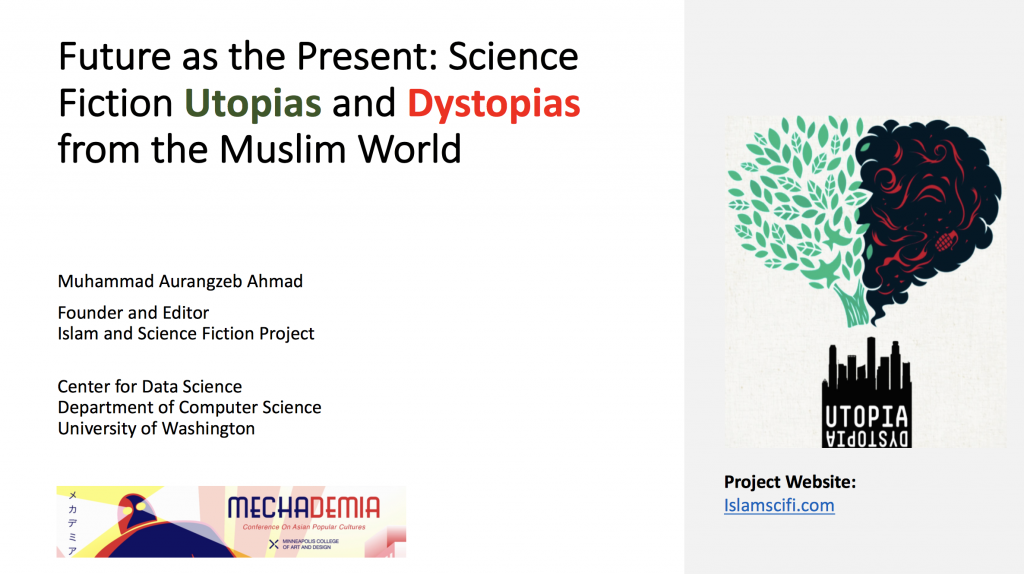
Future as the Present: Science Fiction Utopias and Dystopias from the Muslim World
Muhammad Aurangzeb Ahmad
Abstract: The utopias and dystopias produced by the Muslim world in the last 100 years are a good proxy of the aspirations of Muslim cultures. The themes from some representative utopian/dystopian works will be explored here. The first feminist science fiction utopia was imagined by the Bengali Muslim author Ruqqaiya Sakawat Hussain in 1905. In the 1930s, the Turkish author Raif Necdet imagined a secular Turkish utopia which had broken free from its past. Al-Bud al-Khamis (1987) by Ahmad Raif imagines a group of humans who have become disillusioned with Earth. They arrive on Mars where they find a tolerant and non-violent utopian society, run by an Islam like religion.
Around the same time, the Turkish author Ali Nar envisions a very different utopia in Uzay Ciftcileri (Space Farmers) where group of astronauts from Earth go on a journey, inspired from the Ascension journey of Prophet Muhammad, and land on a utopian planet where the society is organized according to a mystical form of Islam. Ahmad Tawfiq’s (2011) dystopian novel Utopia envisions a near future Arab society rife with deep class divisions where the rich live in Elysium like enclaves and the poor barely have enough to survive. Basma Abdel Aziz’s (2016) novel The Queue is set in a Kafkaesque world where the hopes of Arab Spring have been crushed. It is set in the aftermath of an unsuccessful uprising where the helpless citizens struggle to get by in their daily lives against an absurd sinister dictatorship.
Powerpoint | PDF
]]>Deprecated: Creation of dynamic property WP_Post::$post_category is deprecated in /homepages/15/d218977245/htdocs/wp-includes/class-wp-post.php on line 266
Deprecated: Creation of dynamic property WP_Post::$post_category is deprecated in /homepages/15/d218977245/htdocs/wp-includes/class-wp-post.php on line 266
http://www.islamscifi.com/utopias-and-dystopias-from-the-muslim-world/feed/
Deprecated: Creation of dynamic property WP_Term::$cat_ID is deprecated in /homepages/15/d218977245/htdocs/wp-includes/category.php on line 357
Deprecated: Creation of dynamic property WP_Term::$category_count is deprecated in /homepages/15/d218977245/htdocs/wp-includes/category.php on line 358
Deprecated: Creation of dynamic property WP_Term::$category_description is deprecated in /homepages/15/d218977245/htdocs/wp-includes/category.php on line 359
Deprecated: Creation of dynamic property WP_Term::$cat_name is deprecated in /homepages/15/d218977245/htdocs/wp-includes/category.php on line 360
Deprecated: Creation of dynamic property WP_Term::$category_nicename is deprecated in /homepages/15/d218977245/htdocs/wp-includes/category.php on line 361
Deprecated: Creation of dynamic property WP_Term::$category_parent is deprecated in /homepages/15/d218977245/htdocs/wp-includes/category.php on line 362
Deprecated: Creation of dynamic property WP_Post::$post_category is deprecated in /homepages/15/d218977245/htdocs/wp-includes/class-wp-post.php on line 266
Deprecated: Creation of dynamic property WP_Post::$post_category is deprecated in /homepages/15/d218977245/htdocs/wp-includes/class-wp-post.php on line 266
I will be presenting a paper on Utopias and Dystopias in Islamicate Science Fiction (i.e., Science Fiction from the Islamic world) at the Mechademia International Conference in Minneapolis. I will be presenting remotely from Seattle. Here is the abstract of my paper: Future as the Present: Science Fiction Utopias and Dystopias from the Muslim World Muhammad … Continue reading At Mechademia Conference on Asian Popular Cultures]]>
Deprecated: Creation of dynamic property WP_Post::$post_category is deprecated in /homepages/15/d218977245/htdocs/wp-includes/class-wp-post.php on line 266

I will be presenting a paper on Utopias and Dystopias in Islamicate Science Fiction (i.e., Science Fiction from the Islamic world) at the Mechademia International Conference in Minneapolis. I will be presenting remotely from Seattle. Here is the abstract of my paper:
Future as the Present: Science Fiction Utopias and Dystopias from the Muslim World
Muhammad Aurangzeb Ahmad
Abstract: The utopias and dystopias produced by the Muslim world in the last 100 years are a good proxy of the aspirations of Muslim cultures. The themes from some representative utopian/dystopian works will be explored here. The first feminist science fiction utopia was imagined by the Bengali Muslim author Ruqqaiya Sakawat Hussain in 1905. In the 1930s, the Turkish author Raif Necdet imagined a secular Turkish utopia which had broken free from its past. Al-Bud al-Khamis (1987) by Ahmad Raif imagines a group of humans who have become disillusioned with Earth. They arrive on Mars where they find a tolerant and non-violent utopian society, run by an Islam like religion.
Around the same time, the Turkish author Ali Nar envisions a very different utopia in Uzay Ciftcileri (Space Farmers) where group of astronauts from Earth go on a journey, inspired from the Ascension journey of Prophet Muhammad, and land on a utopian planet where the society is organized according to a mystical form of Islam. Ahmad Tawfiq’s (2011) dystopian novel Utopia envisions a near future Arab society rife with deep class divisions where the rich live in Elysium like enclaves and the poor barely have enough to survive. Basma Abdel Aziz’s (2016) novel The Queue is set in a Kafkaesque world where the hopes of Arab Spring have been crushed. It is set in the aftermath of an unsuccessful uprising where the helpless citizens struggle to get by in their daily lives against an absurd sinister dictatorship.
If you are around be sure to drop a line. Here is the link to the official conference website: Mechademia 2017
]]>Deprecated: Creation of dynamic property WP_Post::$post_category is deprecated in /homepages/15/d218977245/htdocs/wp-includes/class-wp-post.php on line 266
Deprecated: Creation of dynamic property WP_Post::$post_category is deprecated in /homepages/15/d218977245/htdocs/wp-includes/class-wp-post.php on line 266
http://www.islamscifi.com/at-mechademia-conference-on-asian-popular-cultures/feed/
Deprecated: Creation of dynamic property WP_Term::$cat_ID is deprecated in /homepages/15/d218977245/htdocs/wp-includes/category.php on line 357
Deprecated: Creation of dynamic property WP_Term::$category_count is deprecated in /homepages/15/d218977245/htdocs/wp-includes/category.php on line 358
Deprecated: Creation of dynamic property WP_Term::$category_description is deprecated in /homepages/15/d218977245/htdocs/wp-includes/category.php on line 359
Deprecated: Creation of dynamic property WP_Term::$cat_name is deprecated in /homepages/15/d218977245/htdocs/wp-includes/category.php on line 360
Deprecated: Creation of dynamic property WP_Term::$category_nicename is deprecated in /homepages/15/d218977245/htdocs/wp-includes/category.php on line 361
Deprecated: Creation of dynamic property WP_Term::$category_parent is deprecated in /homepages/15/d218977245/htdocs/wp-includes/category.php on line 362
Deprecated: Creation of dynamic property WP_Post::$post_category is deprecated in /homepages/15/d218977245/htdocs/wp-includes/class-wp-post.php on line 266
Deprecated: Creation of dynamic property WP_Post::$post_category is deprecated in /homepages/15/d218977245/htdocs/wp-includes/class-wp-post.php on line 266
A Star Curiously Singing is a novel by Kerry Nietz which envisions a dystopian future where Muslims are in control. Sharia law is the law of the land and slavery exists again but now in a technological form, polygamy is common and women are forced to cover from head to toe. Are there any cliche’s … Continue reading Kerry Nietz’ A Star Curiously Singing]]>
Deprecated: Creation of dynamic property WP_Post::$post_category is deprecated in /homepages/15/d218977245/htdocs/wp-includes/class-wp-post.php on line 266

A Star Curiously Singing is a novel by Kerry Nietz which envisions a dystopian future where Muslims are in control. Sharia law is the law of the land and slavery exists again but now in a technological form, polygamy is common and women are forced to cover from head to toe. Are there any cliche’s left to be added? Here is the description of the novel from the publisher.
]]>If he fixes the robot, will he break his world? In a future ruled by sharia law machines are managed by debuggers, who in turn are owned by masters. Sandfly is a level 12 debugger. He is sent into Earth orbit to repair a robot-a robot that went on an experimental flight into deep space… And tore itself apart. As Sandfly digs into the mystery aboard the space station, he discovers what the bot heard around that distant star. He discovers that the bot heard…singing. As Sandfly pieces together the clues, the masters spread the trap before his feet. Everyone is racing to the same conclusion, but only one side welcomes what the singing represents.